

Concrete commitments to responsible purchasing
Interview
with Hayat Zerouali, Group Purchasing Director

“Our responsible purchasing policy is a lever for improving our financial and non-financial performance.”
“Responsibility lies at the heart of our purchasing teams’ approach.”
Hayat Zerouali, Group Purchasing Director, outlines the challenges and priorities of the Group’s responsible procurement strategy, as well as the action plans implemented across its value chain. across its value chain.
What are the Group’s priorities regarding responsible purchasing?
Responsible purchasing is a key lever in the Group’s sustainability strategy. As such, the Group has two main objectives:
- ensuring responsible and ethical purchasing practices by guaranteeing compliance throughout the value chain;
- contributing to the Group’s greenhouse gas emissions reduction trajectory by integrating climate criteria into purchasing decisions and getting partners and suppliers on board with these commitments.
What advantages will this bring?
Our responsible purchasing policy is a lever for improving our financial and non-financial performance. It aims to strengthen our impact in the long term, guarantee high standards of ethics and responsibility, engage the entire value chain, and strengthen stakeholder confidence. It also contributes to better management of purchasing-related risks, in particular:
- the risk of non-compliance with sector-specific international standards and benchmarks (Kimberley Process, RJC, etc.);
- reputational risk in the event of controversies related to mining conditions or practices that contravene ethical principles;
- the risk of dependence on certain critical raw materials, which could expose the Group to market fluctuations or shortages.
Finally, this policy aims to consolidate lasting and balanced relationships with our partners and suppliers, based on transparency, trust and alignment of long-term commitments.
What is our action plan for achieving this?
The first step was to strengthen procurement governance in order to make it a central focus of the Group’s strategy. To this end, a dedicated function for responsible procurement and traceability was created in 2025, with the appointment of a “Traceability and Purchasing Projects Director”. Following positive results, the Director of Traceability’s remit was broadened to accelerate efforts in product quality and sustainability and to deliver an integrated, end-to-end vision of Responsible Purchasing, Traceability, and Quality.
This change was accompanied by a redefinition of our purchasing strategy, aimed at integrating environmental, social, and ethical criteria into major purchasing decisions. This was placed under the leadership of the Traceability Director, especially for matters relating to new suppliers and sourcing.
The aim is for all purchasing teams to integrate CSR requirements while keeping suppliers deeply involved throughout process via progressive support and enhanced dialogue.
The Group has also launched initiatives to acclimate and train employees, enabling them to better understand these issues, strengthen their pride in belonging to the Group, and be more equipped to answer customer questions about the origin, quality, and sustainability of the products offered.
Can you tell us about your purchasing strategy and the measures you put in place?
Gaining a better understanding of and managing our value chain
We sent all our suppliers a detailed questionnaire on their CSR policies and traceability practices. The responses are analysed using a scoring system, which enables us to better assess risks and guide our purchasing decisions. As a result, more than 95% of our purchases are sourced from suppliers that completed the questionnaire.
Strengthening contractual framework and supplier requirements
The Group’s Responsible Purchasing charter has been strengthened and is now a mandatory commitment for all our suppliers. In addition, we require our partners to be certified according to recognised industry standards in order to guarantee high ethical, social, and environmental criteria.
Rolling out a reinforced audit strategy
During the year, the Group worked on defining and structuring a reinforced audit strategy based on its ESG risk mapping. In FY26, this audit roadmap will be implemented across the value chain, with a focus on higher-risk suppliers and their contractors. Audit results and corrective action plans will be systematically shared with suppliers to drive continuous improvement.
Optimising quality controls
Product quality remains a priority. The Group is investing in new monitoring and control tools to modernise and optimise its processes, with the aim of offering more sustainable products that meet consumer expectations and regulatory requirements.
Reducing greenhouse gas emissions
Finally, the Group has taken decisive steps to significantly reduce its greenhouse gas emissions by integrating climate criteria into its purchasing decisions and engaging its entire ecosystem – suppliers and partners – on this reduction trajectory. Particular emphasis is placed on foundries and gold jewellery suppliers, with initiatives underway to integrate recycled gold into production.

Suppliers certifications
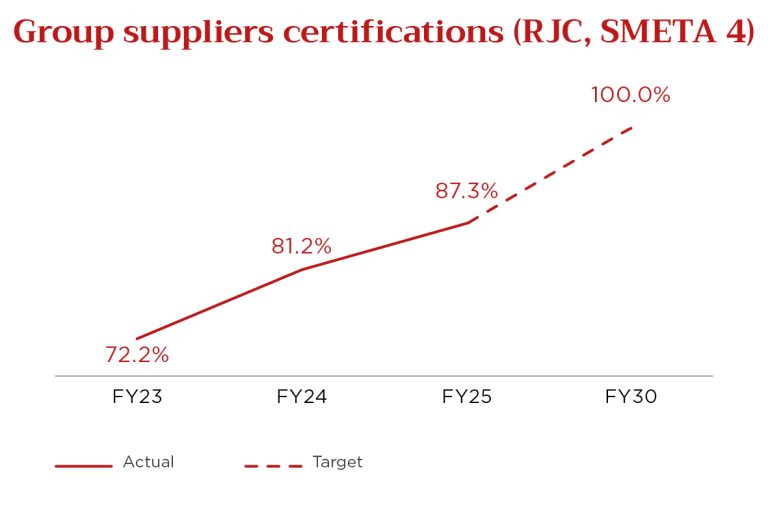
THOM is committed to working exclusively with RJC-certified or SMETA 4-compliant suppliers by 2030. In 2025, THOM made 87% of its non-branded purchases from RJC CoP-certified or SMETA 4-compliant suppliers.
*The RJC certification (Responsible Jewellery Council) is a label that certifies that companies in the jewellery sector adhere to high standards of social and environmental responsibility. The RJC was created to promote ethical practices in the jewellery industry, particularly in terms of material sourcing, the protection of human rights and sustainability.
Companies that obtain RJC certification commit to respecting principles such as:
- Respect for human rights: Ensuring that the rights of employees and communities are protected.
- Environmental practices: Minimising the environmental impact of their operations.
- Traceability: Ensuring that the materials used come from responsible sources.
This certification is often seen as a mark of trust for consumers concerned about ethics and sustainability in their jewellery choices.
SMETA 4 (Sedex Members Ethical Trade Audit version 4) is a widely recognised ethical audit framework developed by Sedex (Supplier Ethical Data Exchange). It is designed to assess and promote ethical business practices within supply chains, particularly in relation to labour rights, health and safety, the environment and business integrity.
Key components of SMETA 4 include:
- Labour Standards: Evaluating working conditions, including issues related to child labour, forced labour, discrimination, and freedom of association.
- Health and Safety: Assessing workplace safety measures and the overall health and safety of employees.
- The Environment: Reviewing environmental practices and compliance with relevant laws and regulations.
- Business Ethics: Ensuring transparency, integrity, and compliance with relevant laws in business practices.
SMETA 4 emphasizes a collaborative approach, encouraging businesses to share audit results to reduce duplication and improve supply chain transparency. It is widely used by companies to demonstrate their commitment to ethical practices.